 Año
22. Nº 1
Año
22. Nº 1
Año
22. Nº 1
FIELD
WORK WITH ALAIN DE TRENQUALYE (JANUARY 13-25 2017)
Dylan H. Cohen
Graduate Student,
Claremont, USA
My research focuses on taxonomy and systematics of Loasa
(Loasaceae). In the summer of 2017, I traveled to
Chile to collect Andean Loasa. It was suggested that I contact Alain de
Trenqualye. I was told he was also working on Loasa, but was not a
professional botanist. I was impressed with his detailed website (http://floradechile.cl/). Alain had spent a
great deal of time photographing and researching Chilean plants, which
were close to his heart. Clearly he was an advocate for Chilean plants, and the
wonders they held.
When I arrived in Santiago, Alain was patiently waiting
for me at the airport. I had never been to Chile, and did not know what to
expect. He drove me to his apartment, prepared lunch, and showed me some of his
favorite books on Chilean plants. We discussed Loasa and he told me his
views and concepts for different species. Later that day, we both went to the
National Herbarium, where we viewed Loasa specimens. Alain graciously
accompanied and helped a complete stranger (me) for no reason other than his
love of plants and pure generosity.
The route for the collecting trip would take us in the
Andes, throughout central and southern Chile. Our first stop was to Farellones and La Parva, where we
met up with Mélica Muñoz-Schick, and collected
several Loasa species, including the rarely collected endemic, “Loasa”
caespitosa. Alain had suggested that we hike up a
path, where he found a single individual before. I was amazed by how easily
this man bounded up the mountains like a goat, while I lagged behind. After a
long and difficult hike we came across a population at 3000m. We were both
filled with joy to observe a rarely collected Loasa.
After Farellones, we
botanized/collected in many places including: El Roble,
El Morado/San José de Maipo, Rio Pangal, El Planchón/Laguna Teno, Altos de Lircay, Laguna de Maule, Termas de Chillán, near Concepción and Laguna del Laja. Every
location we visited we collected Loasa. We explored some amazing places
that are not often seen.
I have many fond memories from this trip with Alain.
From eating watermelon and collecting Blumenbachias
at Laguna del Maule, to finding Loasa acanthifolia, and other plants we had not observed
before. I recall one day we traveled to Laguna Teno;
Alain was instrumental, helping navigate the correct roads to eventually get to
the locality. The path was steep and windy. I was a little nervous driving on
such a road, but Alain was not shaken for a moment. Earlier that morning, Alain
spotted Andean condors flying overhead leading our path, perhaps a good omen
from above. It took some time and careful driving, but we eventually reached
the Laguna, and along the way collected Loasa, Blumenbachia, and Pinnasa. While I pressed the plants, and collected
leaf tissue for silica, Alain would identify all of the associate plants and
take notes. He would always photograph the plants, perhaps to eventually add to
his website.
A few days later we were collecting near Chillán and Alain informed me of a locality we should
explore. This locality involved hiking a difficult path through forested areas,
lava field, and then up a very steep mountain. This was an all-day adventure
with much trekking. The goal was to take a path that would lead us to Laguna del Huemul, to a population that
had never been collected. We found the plants growing on sharp steep cliffs. We
continued the way to the top to see the lake. There were many families enjoying
the cool waters (apparently there was an easier way to access the Laguna).
Alain, always enthusiastic about plants, began to explain to some young people
what we were doing and the importance of conserving Chilean plants.
Alain’s story is one of inspiration and promise. From
civil engineer to an enthusiastic botanist, a man with a love and thirst for
knowledge about the Chilean flora. Alain and I parted ways in Los Ángeles,
I thanked him for all his help and guidance. My road ahead would be alone, but
I had confidence from working with Alain.
Over the past few years I continued my research as a
student, keeping in touch with Alain. I kept telling him I would be back to
make collections of the spring time Loasa. This would be this year. A
few weeks ago I was told by Mélica that Alain was
sick and in the hospital. She suggested me to write him. I wrote and told him I
would be returning to Chile, and that I would like to see him, and if he felt
well enough that he should join me in the field. I am not sure if he ever saw
the email or not. I am still coming to Chile in October, and I know he will be
guiding me from above excited to observe and collect Loasa from the Chilean
countryside, just like before. Every day with Alain was a good day, rest in
peace my friend.
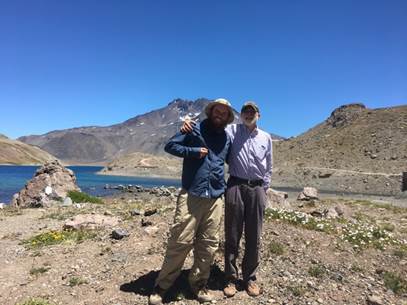
Alain de Trenqualye and Dylan Cohen
at Laguna Teno (2017).
Volver a la versión en español